
Beyond the Hype: Deep Learning Advancements in 2026
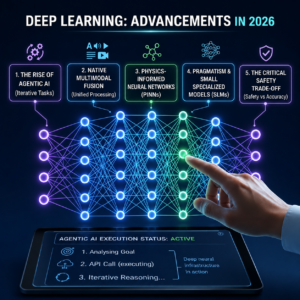
If previous years were defined by AI experimentation, 2026 is the year deep learning became the invisible infrastructure of the modern enterprise.
According to the Stanford HAI 2026 AI Index Report, generative AI has reached a staggering 53% population adoption faster than both the PC and the internet, with global AI spending projected to touch $2.02 trillion this year.
Here are the key technical breakthroughs driving deep learning forward today.
1. The Rise of “Agentic AI”
We have moved past passive, prompt-based chatbots. Today’s neural networks utilize advanced reinforcement learning and iterative reasoning loops to break down complex goals, use external APIs, and execute multi-step tasks independently.
- The Impact: A recent Cisco/Omdia corporate survey revealed that 80% of business executives view agentic AI as critical to company survival, expecting over half of their workforce to actively collaborate with AI agents within 24 months.
2. Native Multimodal Fusion
Early models stitched separate vision and text architectures together. In 2026, frontier neural networks are natively multimodal—processing text, audio, live video, and structural data simultaneously within a unified latent space.
- Intelligence at the Edge: Massive strides in model compression and on-device neural engines have successfully brought true multimodal processing directly to smartphones and industrial IoT devices without needing constant cloud reliance.
3. Physics-Informed Neural Networks (PINNs)
Deep learning has expanded beyond purely statistical guessing. By embedding the laws of physics, thermodynamics, and fluid dynamics directly into a neural network’s loss functions, AI outputs remain scientifically accurate even with sparse data.
- Real-World Breakthroughs: Researchers are successfully deploying PINNs for verifiable climate modelling, while pharmaceutical giants are utilizing massive deep learning supercomputers to simulate molecular hypotheses, cutting traditional drug discovery timelines in half.
4. Pragmatism & Small Specialized Models (SLMs)
The “bigger is better” parameter race has hit a wall known as the “jagged frontier”—where a massive model can solve Olympiad-level math but still fail to read a basic analog clock. The Pivot: Due to high compute costs, the industry has aggressively pivoted toward highly curated, domain-specific SLMs. These smaller networks frequently outperform generalized giants in precision, latency, and operational cost.
5. The Critical Safety Trade-Off
As capabilities accelerate, managing AI safety risks has become paramount. MLOps teams in 2026 are tackling a tough technical reality: heavily prioritizing safety safeguards can sometimes degrade a model’s raw factual accuracy. The mandate for 2026 has shifted from mere performance optimization to foundational data governance and risk compliance. Deep learning in 2026 isn’t about chasing a singular, all-knowing sci-fi intelligence. It is about a highly specialized ecosystem of agentic, native-multimodal, and physics-compliant models. For businesses, the ultimate competitive edge is no longer just owning data—it is the ability to safely orchestrate these advanced networks.
Sources:
https://hai.stanford.edu/ai-index/2026-ai-index-report
https://machinelearningmastery.com/7-machine-learning-trends-to-watch-in-2026
https://www.crescendo.ai/news/ai-breakthroughs-and-latest-ai-news-2026
https://www.trigyn.com/insights/ai-trends-2026-new-era-ai-advancements-and-breakthroughs