
Edge AI in Environmental Sensors
Introduction
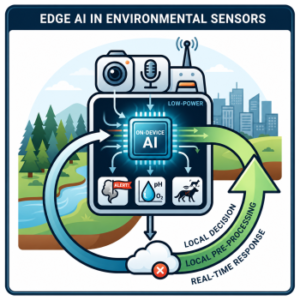
Imagine a forest sensor detecting the very first traces of smoke from an emerging wildfire. Instead of routing raw data through a fragile connection to a distant cloud server and waiting minutes for analysis, the sensor instantly evaluates the threat locally and issues a warning within seconds.
As climate change, urban pollution, and habitat degradation continue to increase worldwide, researchers and environmentalists are turning to Edge AI to monitor forests, oceans, rivers, and air quality faster and more accurately than ever before.
What is Edge AI in Environmental Sensors?
Edge AI is the deployment of artificial intelligence (AI) on devices that process data where it is collected, rather than sending it to a distant cloud server. This enables faster analysis, reduces communication delays, and allows devices to make real-time decisions.
In environmental sensors, Edge AI helps monitor conditions such as air quality, water quality, temperature, humidity, and wildlife activity by analyzing data directly on the sensor. This allows environmental changes to be detected quickly, even in remote areas with limited internet connectivity.
Applications of Edge AI in Environmental Sensors
Air Quality Monitoring: Edge AI helps monitor harmful pollutants such as particulate matter (PM2.5), carbon monoxide, and nitrogen dioxide in real time. By analyzing data locally, sensors can quickly detect poor air quality and send immediate alerts.
Water Quality Monitoring: Smart water sensors continuously monitor parameters such as pH, temperature, dissolved oxygen, and chemical contamination. Edge AI enables instant detection of water quality changes without relying on cloud processing.
Forest Fire Detection: Edge AI-powered cameras and thermal sensors can identify smoke, heat, and fire patterns at an early stage. This helps authorities respond quickly and reduce the spread of wildfires.
Wildlife Monitoring: Environmental cameras and acoustic sensors use Edge AI to identify animal movements, monitor endangered species, and detect illegal activities such as poaching in remote forests.
Precision Agriculture: Edge AI analyzes data from soil moisture, nutrient, and weather sensors to support efficient irrigation and crop management, helping farmers improve productivity while conserving resources.
Climate and Weather Monitoring: Weather stations equipped with Edge AI monitor temperature, rainfall, humidity, and wind conditions in real time, providing faster insights into changing environmental conditions.
The Stages of Edge AI in Environmental Sensing
Edge AI processes environmental data through a structured pipeline, enabling sensors to analyze information locally and respond in real time.
Stage1:Data Collection
Environmental sensors continuously collect data such as temperature, humidity, air quality, water quality, and sound. Edge devices perform initial filtering to improve data quality.
Stage 2: Data Preprocessing
The collected data is cleaned, normalized, and transformed into meaningful information before AI analysis.
Stage 3: On-Device AI Analysis
Optimized AI models running directly on the device analyze the processed data to detect patterns, identify anomalies, and recognize events such as pollution, wildfires, or wildlife activity.
Stage 4: Local Decision-Making
Based on the AI analysis, the edge device immediately triggers alerts, records important events, or activates safety mechanisms without depending on cloud connectivity.
Stage 5: Selective Data Transmission
Only important insights, alerts, and summarized information are transmitted to the cloud, reducing bandwidth usage and communication costs.
Stage 6: Continuous Learning
Complex or uncertain data is uploaded for model improvement. Updated AI models are then deployed back to edge devices, improving their performance over time.
Benefits of Edge AI in Environmental Sensors
- Faster Decision-Making
- Reduced Network Usage
- Reliable Operation
- Continuous Improvement
Challenges and Limitations
Although Edge AI offers many benefits for environmental monitoring, it still faces several challenges that limit its widespread adoption.
Limited Hardware: Environmental sensors often have limited processing power, memory, and storage, making it difficult to run advanced AI models directly on the device.
Power Consumption: Many environmental sensors are deployed in remote areas and rely on batteries or solar power. Running AI models continuously can reduce battery life and affect long-term operation.
Model Updates: Environmental conditions change over time, requiring AI models to be updated regularly. Updating large numbers of remote sensors can be time-consuming and challenging.
Harsh Environmental Conditions: Sensors deployed in forests, rivers, deserts, and oceans must withstand extreme temperatures, humidity, dust, and heavy rainfall while maintaining accurate and reliable performance.
Research Perspective of Edge AI in Environmental Sensors
Real-Time Environmental Monitoring
Researchers are developing lightweight AI models that can process environmental data directly on sensors with minimal delay. This helps detect pollution, forest fires, and water contamination more quickly while reducing dependence on cloud computing.
Energy-Efficient Smart Sensors
Current research focuses on designing low-power Edge AI hardware that allows environmental sensors to operate for longer periods using batteries or solar energy. This enables continuous monitoring in remote locations with minimal maintenance.
Intelligent Environmental Monitoring
Researchers are improving AI algorithms that can accurately monitor ecosystems, detect wildlife activity, identify pollution sources, and observe climate changes. These intelligent systems provide more reliable environmental data for conservation and sustainable resource management.
Industry and Academic Collaboration
Research collaborations between universities and technology companies are accelerating the development of next-generation Edge AI technologies. For example, Qualcomm’s collaboration with the University of California San Diego aims to develop energy-efficient Edge AI solutions that support real-time environmental sensing and other intelligent edge applications.
Conclusion
Edge AI is transforming environmental monitoring by enabling sensors to process data locally and make real-time decisions. Its applications in air quality monitoring, wildlife conservation, forest fire detection, and climate monitoring are helping create smarter and more efficient environmental systems. As Edge AI continues to evolve, it will play a key role in building a safer and more sustainable future.
Sources
https://www.eduinx.in/blog-repository/Edge-AI-Trends-2026-Real-Time-Data-Processing-at-the-Source.php
https://www.qualcomm.com/news/releases/2026/06/sdg-e–qualcomm-and-uc-san-diego-launch-edge-ai-collaboration-to
https://www.meegle.com/en_us/topics/edge-ai-solutions/edge-ai-in-environmental-research