
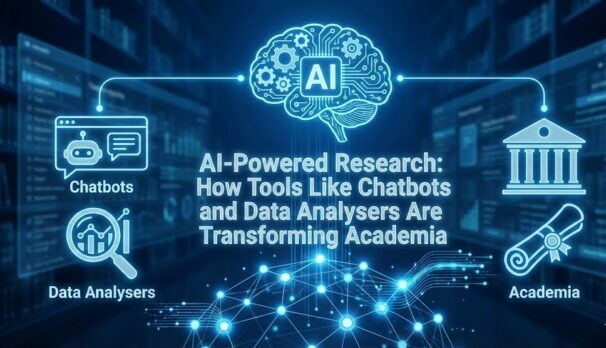
Artificial intelligence has emerged as one of the most powerful drives that are rapidly affecting academic research in all fields. Researchers are also experiencing a trend towards more rapid, effective, and productive scientific research with the growth of intelligent chatbots and sophisticated data analysers. These artificial intelligence tools assist in every step of literature review to the interpretation of large data sets, and thus, are indispensable companions to the creation of knowledge in the present era. However, as much as they present transformative advantages, they also introduce the issue of responsible use, originality and academic integrity, which is the reason why they should be used judiciously by institutions and researchers.
Chatbots as Intelligent Research Assistants
Chatbots based on AI like ChatGPT, Gemini, and academic assistants specific to a domain are currently integrated into research and learning processes. They assist scholars in writing and revising material and summarizing lengthy papers, experiment planning, conceptual clarity, and even troubleshooting coding or statistical problems. A core benefit of them is flexibility: chatbots can make different explanations depending on the background of a user, are able to simplify complex theories, provide options when a user does not understand an argument, and reorganize material to be easier to read.
These tools provide an easy learning experience to students through breakdown of difficult subjects, creation of examples and providing customized study tools. To researchers, they lighten the cognitive burden of a reading intensive or writing intensive task enabling more time to be spent on creativity, critical thinking and more in deep analysis.
Artificially Intelligent Data Analysers Powering up Scientific Discoveries
In addition to support in the writing and ideation process, AI-driven data analysers are transforming technical research processes. The tools automate the key steps that are to clean data, normalize it, extract features, build models, and visualize them. They are able to find discreet correlations, execute sophisticated machine learning pipelines, analyze the results of hypotheses, and create predictive insights to high precision.
Areas with large and complicated data, healthcare, climate science, autonomous systems, neuroscience, agriculture, or social analytics are getting massive benefits by AI to process information in a manner that cannot be done by any human being. However, when AI is used to discover meaningful patterns in raw data, it not only increases discovery speed but also raises the likelihood of reproducibility and lowers the likelihood of human error.
Providing Ethical and responsible Use
The increasing role of AI in academia is associated with the issue of being over-dependent, losing originality, and losing the ability to think critically. Institutions are currently perfecting their directives to make sure that AI does not undermine learning, but supplement. Ethical use practices are:
- Training students on the application of AI as an aide and not a work finisher.
- Promoting thoughts, theory-practice, and customization of assignments.
- The only use of the AI detection tools is as a supplementary check.
- Creating tests with less chance of abuse.
- Educators can make sure that AI can facilitate productivity of research and not compromise authenticity by creating awareness and responsibility.
Revamping Research Across the Board
The influence of AI has been felt in all fields of academics:
- Life Sciences: biomarker discovery, disease classification, detection of genomic patterns.
- Engineering: autonomous system behaviour analysis, simulation modeling, optimization.
- Environmental Studies: weather forecasting, risk analysis, satellite imagery.
- Social Sciences: behavioral analytics, policy analysis, sentiment mining.
- Education Research: prediction of early performance, adaptive learning systems.
Chatbots and data analysers that are run by AI are transforming the way academia engages with research and learning. Based on the data-driven insights, they streamline the time-consuming activities, enhance the deep-seated understanding, and open up the opportunities. Despite the issues, especially in the area of upholding academic integrity, their responsible incorporation can make the scholarly work of a high quality and impact. With the ongoing development of research in the AI-controlled world, it has to continue being focused on enhancing human intelligence with these tools, not on substituting it to ultimately create a future where innovation, ethics, and discovery would continue to advance together.
- https://www.facultyfocus.com/articles/teaching-with-technology-articles/chatbots-in-higher-education-benefits-challenges-and-strategies-to-prevent-misuse/
- https://learning.uic.edu/news-stories/report-on-student-attitudes-towards-ai-in-academia/
- https://ascode.osu.edu/news/rise-chatbots-higher-education-transforming-teaching-learning-and-student-support